This website use cookies to ensure you get the best experience on our website
Maintenance Tips
Keeping your home well-maintained is a team effort, which means you need to play an active role. Here you'll find tips on how to keep up on minor maintenance items that are your responsibility, other maintenance items that are our responsibility, and how to tell the difference!
In addition to ordinary things like household cleaning and yardwork, tenants are responsible for taking care of routine things like replacing HVAC filters, light bulbs, and smoke detector batteries. But you are also responsible for keeping an eye (and ear) on other potential maintenance issues and resolving them before they become a more serious problem.
Plenty of small things can be easy to ignore, but have the potential to become a major issue. For instance, you might be tempted just to put a bowl under a slow leak at your kitchen faucet, but a slow leak can easily develop into a fast leak or even a full-blown flooding situation. If anything doesn't work right, look right, sound right, or whatever, let us know. Put in a service request through your tenant portal and we'll get it taken care of. In most cases, the owner will pay for these sorts of repairs. On the other hand, if you ignore a small ongoing problem that could have been easily resolved had we known about it, additional costs (such as carpet dryout, flooring and drywall repairs, etc.) could end up being your responsibility. Just do it the easy way. Let us know and we'll get it taken care of.
Usually, nothing. The property owner is responsible for repairing most things, major or minor. However, it can work against you if you're not keeping up with routine items. For example, if your A/C stops working and the service tech finds the system has frozen up because you never changed the filter, you may be on the hook for all or part of that service call. Obviously, if you have broken something, you might be held responsible to some degree, but it won't help to keep it a secret anyway. Just let us know about the issue as soon as possible. We'll fix the problem and distribute the cost as fairly as we possibly can.
Heating and Air Conditioning
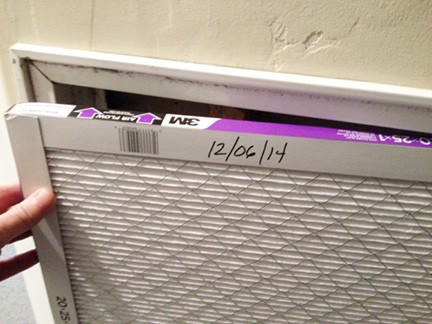
The only routine maintenance tenants are expected to do on heating and air conditioning is replacing filters. There are four main reasons you want to keep up on filters to prevent them from getting dirty.
- Your lease requires it
- If you don't do it and it causes avoidable problems with the system, you may be held liable for a service call
- Frequently changing filters keeps your home cleaner and helps the system cool and heat better for your comfort
- Since the system runs more efficiently, you can typically help you save some money on your power bills
Be sure to change your filters at least quarterly (every three months), and more often if you find them obviously dirty upon changing. Filters can be rather expensive, but most service technicians recommend buying the cheap ones and just replacing them more often. The fancier, more expensive filters clog faster and can cause your system to work much harder. In extreme cases, a filter can become so clogged that it will collapse and get sucked into the ductwork, dumping big clumps of dusty lint into the system, which is worse than having no filter at all.
Another common issue with central heating and cooling is that the batteries in the thermostat go dead. Even though these systems are obviously powered by household current, a couple of dead AA batteries can cause the whole system to go down. If you feel comfortable opening the thermostat to replace the batteries, feel free to do so. It's a quick fix that will get things humming again. If you're not sure, let us know and we'll get it taken care of for you.
Smoke and CO (Carbon Monoxide) Detectors
These lifesaving devices require almost no maintenance at all, except that battery operated units will occasionally need fresh batteries. Often, you'll find this out when it starts chirping (usually at 3:00 am! Why?). Replacing these batteries is generally the tenant's responsibility, but there are times when we may want to get involved.
- If the detector is high enough that you need a tall ladder to get to it, please don't take any unnecessary chances.
- Some units have very long life batteries in them that can't actually be replaced. In these cases, we'll have to buy and install new detectors.
- Some units don't have batteries at all. We generally have to troubleshoot the whole system to resolve the issue.
The key issue is that if a smoke detector isn't working properly, we consider that a safety issue and need to get it resolved as soon as possible. Do what you can, but if you can't take care of it on your own, don't put yourself at risk. Let us know and we'll get you and your home protected again.
Plumbing and Fixtures
Obviously we don't expect you to perform plumbing repairs (in fact, we strongly discourage it!), but there are things you can do to keep things flowing. Mostly, you just need to be observant and help us prevent small problems from turning into major problems.
- One of the commonest plumbing issues we have is toilets that have been clogged with toys and other random small items. These can cause very stubborn clogs that will require the toilet to be removed, whereupon the plumber will find Batman wedged into the trap. If you have a child who's at "that stage," make a point of keeping toilet lids secure, for instance, with one of these gadgets.
- If your water seems to have extremely high pressure, you may hear "hammering," especially when clothes washers or dishwasher are going through their cycles. If so, this can present a risk of a catastrophic plumbing failure, so let us know and we'll have a qualified plumber check it out.
- If your water heater heats unreliably (sometimes not hot enough and sometimes scalding hot), this is often a simple fix (bad thermostat) that's better handled sooner rather than later. Again, let us know by requesting service through your Tenant Portal.
- If your water bill suddenly shoots up dramatically for no apparent reason, that could be an underground leak after the meter.
As bad as a burst pipe can be, the biggest threat in most homes is a slow leak that constantly dribbles water, causing damage to cabinetry, flooring, subflooring, and drywall. By the time anyone notices, the damage can be quite extensive--and expensive. Therefore, please keep an eye out for damp spots and even the smallest leak: around toilets, sinks, and water heaters and other appliances.
Electrical Issues
Electrical work is nearly always something we'll take care of, but there are some things you can do.
- First of all, if you find that multiple outlets or circuits have gone dead, please check your breaker box before requesting service. Electricians are quite expensive, so while we're happy to send someone out for a genuine electrical problem, we don't want to have the come out just to reset a breaker. Same for GFCI (ground fault circuit interrupters).
- Don't just keep resetting a breaker or GFCI if it keeps tripping though. These are safety devices designed to prevent circuit overloads and problems with grounding. If they keep tripping, that could indicate that you're either plugging in to many things into an outlet, or that we need to have a professional check things out.
- Electrical issues can put both you and the home at risk, so if you notice anything that doesn't seem right, we want to know about it. Tripping breakers, flickering lights, exposed wires, outlets or switches that are warm to the touch, and burning smells are all things we want to get taken care of before they present a hazard.